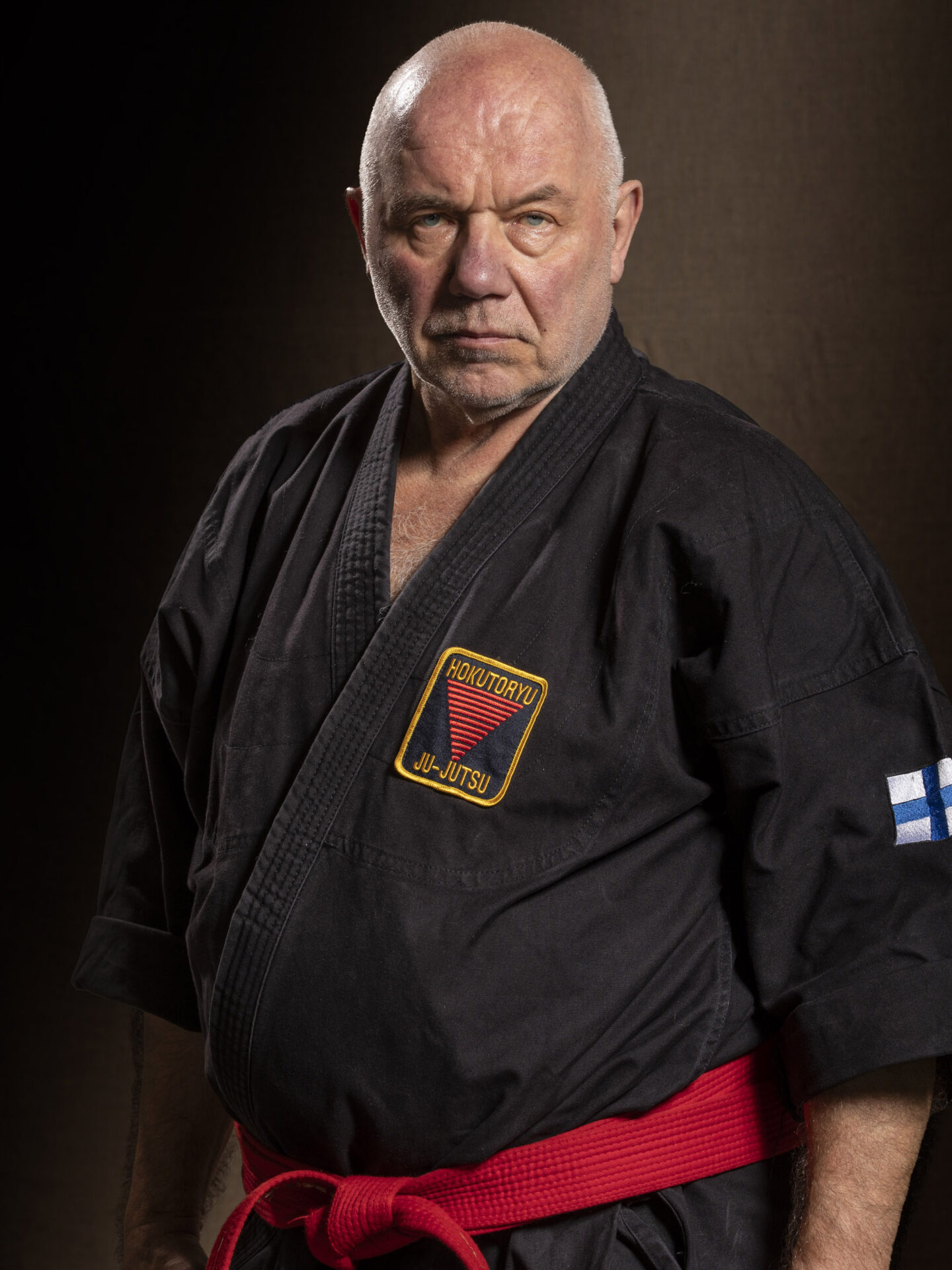
 Auvo Niiniketo, known as the “Father of Finnish Ju-Jutsu,” has practiced martial arts for nearly his entire life. His combat career began with boxing in club Helsingin Voimailijat, when Niiniketo was eight years old. His top boxing achievements include the Finnish Youth Championship in the 75 kg category (1972) and a bronze medal in the senior Finnish Championships (1974).
Niiniketo was first introduced to ju-jutsu in Stockholm, Sweden, where he went for boxing training. After ending his active boxing career, Niiniketo began practicing karate as well, winning the Finnish Championship in the heavyweight category in 1979.
Niiniketo earned his first ju-jutsu belts up to the blue belt level in Sweden. In 1977, he started the first ju-jutsu course at the training hall of club Helsingin Voimailijat. After this, he founded the club Helsingin ju-jutsuklubi (Helsinki Ju-Jutsu Club).
In 1978, Niiniketo met the English senseis Richard Morris and Robert Clark, marking the beginning of a fruitful collaboration. Clark and Morris awarded Niiniketo his first Dan in 1979.
On March 8, 2014, Niiniketo received the highest possible Dan rank in ju-jutsu: 10th Dan. The diploma was signed by representatives of all the world’s major ju-jutsu styles. In Hokutoryu Ju-Jutsu, Niiniketo holds the title of Soke, a title that can be held by only one person in the style worldwide at any given time.
According to Niiniketo, Hokutoryu Ju-Jutsu is a martial arts system that everyone can draw from. The style offers a versatile and challenging practice suitable for both beginners and more advanced practitioners.
Hokutoryu is a realistic and effective method of using force for security personnel, police officers, and military personnel.
The idea behind Hokutoryu is strong fundamental techniques and effective technique combinations. Training is physically demanding from the very beginning, and higher-level belt tests include contact sparring. “A student who has achieved a high rank but is actually weak may reflect poorly not only on their instructor, but also on the belt-awarding authority, the club, the style, and the art itself.”